Keep the ERP as the engine. Add the customer operating layer it is missing.
The CRM should not duplicate inventory, MRP or order accounting. Its role is to connect customer, site, product, quote, order and service relationships; surface commercial exceptions; and give customer-facing teams one managed view of what needs action across ERP and external data.
Research reviewed 2026-09-09. Product and regulatory claims link to primary sources below.
Direct answer
Where does a CRM fit in a manufacturer or distributor that already has ERP?
The CRM should not duplicate inventory, MRP or order accounting. Its role is to connect customer, site, product, quote, order and service relationships; surface commercial exceptions; and give customer-facing teams one managed view of what needs action across ERP and external data.
Search topics covered:manufacturing CRM Canadadistribution CRMERP CRM integrationCRM for B2B distributorsmanufacturing sales CRM
The problem
Where the operating gaps actually are
Manufacturers and distributors often already have capable ERP systems. The opportunity is not replacing them—it is fixing the relationship and commercial handoffs that remain fragmented around them.
CRM and ERP hold different pieces of the customer
Sales context, order history, inventory, product and service status often require cross-system lookup.
Quote-to-order handoffs can lose context
Changes, delays, product substitutions or pricing exceptions need clear ownership on the customer side.
Account hierarchies are complex
Parent companies, sites, distributors, products and installed assets need richer relationships than a flat contact database.
Forecasts depend on operational truth
Sales projections can be misleading if they do not reflect actual orders, agreements and supply constraints.
Tariff and supply disruption can change commercial priorities
External change matters when it can be mapped to affected products, accounts and commitments.
Installed-base/service follow-up can be disconnected
Post-sale relationships may not be visible to the salesperson or account manager.
Channel relationships obscure the end customer
Distributor and manufacturer ownership can require multi-party relationship models.
Master-data quality is a cross-system problem
Customer, site and product identifiers have to align before automation and reporting can be trusted.
The managed model
How Vyop would run the layer
The exact automation and integrations depend on the source systems and governance requirements of each client.
Five-way comparison
Vyop vs the alternatives
Vs Epicor / Infor / Odoo / Salesforce Manufacturing
What the vertical incumbent does well: ERP, inventory, manufacturing, fulfillment and increasingly CRM, forecasting and customer-service functions. Where Vyop fits: Keep ERP as the operational source of truth. Use Vyop/Twenty only where the customer-facing relationship and exception layer remains weak or fragmented across systems.
Vs general CRMs
Salesforce Manufacturing offers deep industry sales capabilities and ERP/order integration. Twenty competes on focus, control and economics for organizations that do not need the full enterprise stack.
Vs self-managed Twenty / in-house CRM
Manufacturers with integration engineering can build Twenty around their ERP. Vyop must add reusable connector patterns, master-data rules, exception models and managed operations.
Vs other managed CRM services
ERP/CRM integrators are established. Vyop should enter only with a narrow repeatable SMB/mid-market use case and faster/lower-TCO managed control layer.
Directional scorecard
Star comparison by operating requirement
| Option | Vertical workflow fit | Flexibility | Cross-system orchestration | Data integrity operations | Managed ownership | Deployment / data control | Choose it when… |
|---|---|---|---|---|---|---|---|
| Vyop Managed CRM on Twenty | Best when the problem is cross-system, requires a bespoke operating model and needs continuous managed ownership. | ||||||
| Epicor / Infor / Odoo / Salesforce Manufacturing | Best when native vertical depth and system-of-record functionality matter more than bespoke cross-system orchestration. | ||||||
| Salesforce / Dynamics / HubSpot | Best when enterprise breadth, ecosystem and internal CRM capability justify the larger platform. | ||||||
| Self-managed Twenty | Best for organizations with technical ownership that want open customization and can run the operating model themselves. | ||||||
| Other managed CRM services | Best for conventional CRM implementation, administration, migration and RevOps without a deep vertical operating layer. |
How to read this: 1–5 scores are Vyop's directional strategic-fit assessment based on product scope and the managed-service model—not an independent lab benchmark, uptime test or universal product rating. They are intentionally explicit so buyers can challenge the assumptions.
Spider chart
The shape of the trade-off
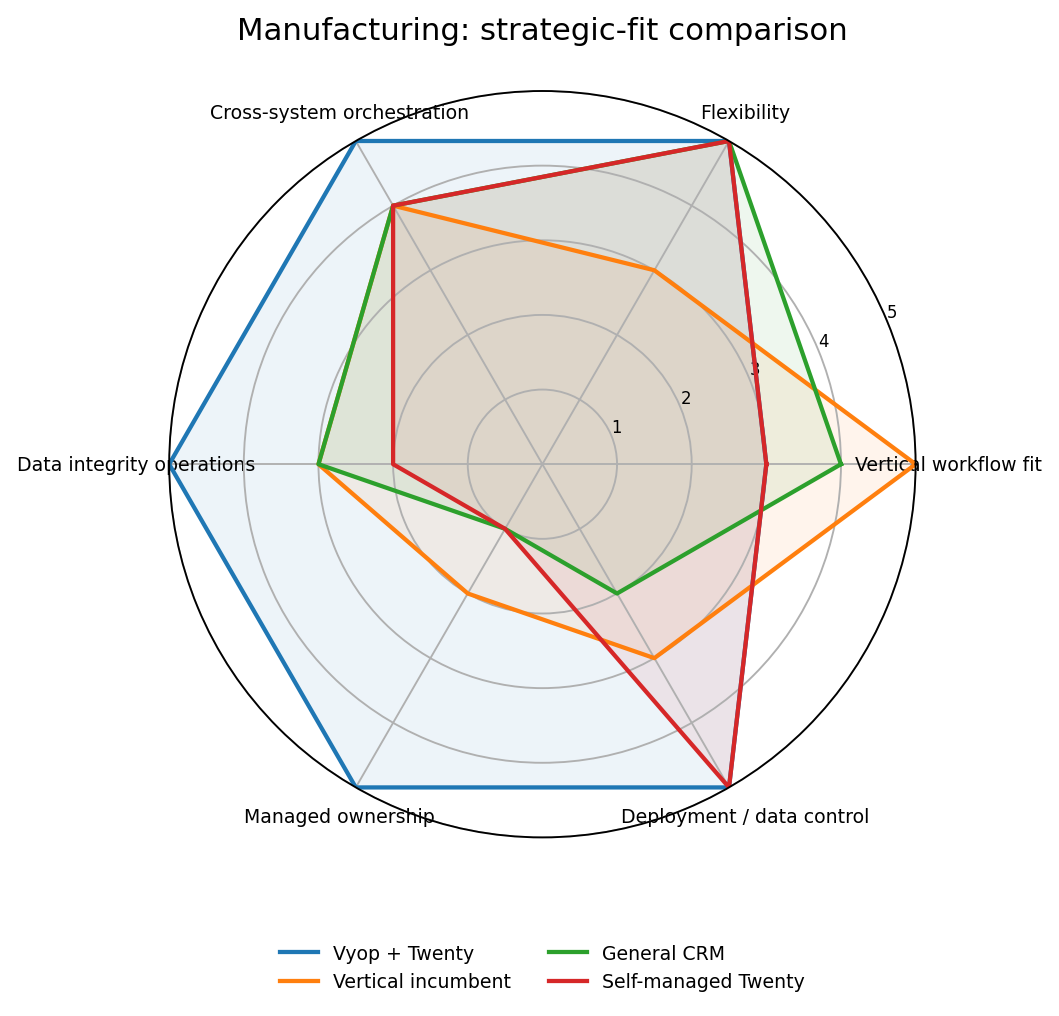
The vertical incumbent usually wins on native industry depth. General CRMs win on ecosystem breadth. Self-managed Twenty wins on control. The proposed Vyop model is designed to win where custom orchestration, continuous data integrity and managed operational ownership matter together.
The radar chart uses the same directional 1–5 scores shown in the comparison table.
Fit
Who should—and should not—choose this approach?
Best fit
Manufacturers and distributors whose ERP runs operations adequately but customer-facing teams still reconcile account, product, quote/order or service information manually.
Probably not a fit
Organizations looking for MRP, inventory, warehouse management, production planning or a replacement ERP.
Buyer questions
Questions worth answering before you buy
Evidence
Sources used for this comparison
Vendor links are used to verify what those products claim to offer. Regulatory and professional-body sources are used for obligation and industry-context claims. Vyop's comparison and recommended architecture are analysis, not claims made by those sources.
- Government of Canada, Advanced manufacturing workforce announcement (Government)
- Salesforce, Manufacturing Cloud for Sales (Official product source)
- Epicor, Kinetic CRM (Official product source)
- Infor, Distribution ERP (Official product source)
Last reviewed: 2026-09-09. Because CRM, AI and regulatory capabilities change, comparison pages should be re-reviewed at least quarterly and whenever a cited product changes materially.
See whether the managed layer is actually justified
The first assessment should identify your systems of record, the exceptions your team still reconciles manually, the data-quality failures that break reporting, and which actions genuinely require human judgment.
Request a CRM Operating Assessment