From tariff change to the exact clients that need action
The opportunity is not another TMS or tariff database. It is the impact layer between external change and commercial action: identify the affected products, clients, quotes or shipments; create the right repricing or notification task; capture evidence; and measure how quickly the business responded.
Research reviewed 2026-09-09. Product and regulatory claims link to primary sources below.
Direct answer
What is the useful CRM gap in freight and customs operations?
The opportunity is not another TMS or tariff database. It is the impact layer between external change and commercial action: identify the affected products, clients, quotes or shipments; create the right repricing or notification task; capture evidence; and measure how quickly the business responded.
Search topics covered:CRM for freight brokers Canadacustoms broker CRMlogistics CRM Canadatariff impact automationfreight forwarding CRM
The problem
Where the operating gaps actually are
Trade information changes outside the company while the economic impact lives inside customer, product, quote and shipment records. Slow reconciliation can turn a regulatory change into a margin or service problem.
Tariff and customs changes move faster than account workflows
Teams need to know which live business is affected, not just read an announcement.
HS and product master data determine impact accuracy
Wrong or incomplete classifications produce false positives and missed clients.
CARM and official systems define the compliance boundary
A CRM should not pretend to replace customs filing or the official record.
Open quotes can be priced on stale assumptions
A change can affect margin before the next normal review cycle.
Client communication requires speed and precision
Account managers need an explainable affected-record list and approved communication path.
TMS, customs, rate, CRM and accounting data are separate
The core work becomes integration and entity matching.
Responsibility needs evidence
The workflow should preserve what changed, which records were identified, who reviewed them and what action was taken.
Generic alerts create noise
The useful system filters change into customer-specific exceptions rather than pushing every update to every user.
The managed model
How Vyop would run the layer
The exact automation and integrations depend on the source systems and governance requirements of each client.
Five-way comparison
Vyop vs the alternatives
Vs Magaya / Descartes / GoFreight / customs systems
What the vertical incumbent does well: Freight execution, customs filing, rate management, shipment data and specialized trade/HS content. Where Vyop fits: Use these platforms as execution systems and data sources. Vyop/Twenty should own the change-to-impact-to-action layer when no single installed platform connects external changes cleanly to account management.
Vs general CRMs
A general CRM can hold accounts and opportunities but does not arrive with TMS, shipment, HS-code or tariff relationships. Twenty's flexible object model is useful if Vyop supplies the integrations and domain rule layer.
Vs self-managed Twenty / in-house CRM
The logic can be self-built. The ongoing burden is maintaining feeds, mappings, sync health, exception rules and action SLAs every time tariffs, schemas or systems change.
Vs other managed CRM services
An integration MSP can connect APIs. The stronger Vyop proposition is to operate a measurable trade-impact control process, including data integrity and human approval—not simply move data between systems.
Directional scorecard
Star comparison by operating requirement
| Option | Vertical workflow fit | Flexibility | Cross-system orchestration | Data integrity operations | Managed ownership | Deployment / data control | Choose it when… |
|---|---|---|---|---|---|---|---|
| Vyop Managed CRM on Twenty | Best when the problem is cross-system, requires a bespoke operating model and needs continuous managed ownership. | ||||||
| Magaya / Descartes / GoFreight / customs systems | Best when native vertical depth and system-of-record functionality matter more than bespoke cross-system orchestration. | ||||||
| Salesforce / Dynamics / HubSpot | Best when enterprise breadth, ecosystem and internal CRM capability justify the larger platform. | ||||||
| Self-managed Twenty | Best for organizations with technical ownership that want open customization and can run the operating model themselves. | ||||||
| Other managed CRM services | Best for conventional CRM implementation, administration, migration and RevOps without a deep vertical operating layer. |
How to read this: 1–5 scores are Vyop's directional strategic-fit assessment based on product scope and the managed-service model—not an independent lab benchmark, uptime test or universal product rating. They are intentionally explicit so buyers can challenge the assumptions.
Spider chart
The shape of the trade-off
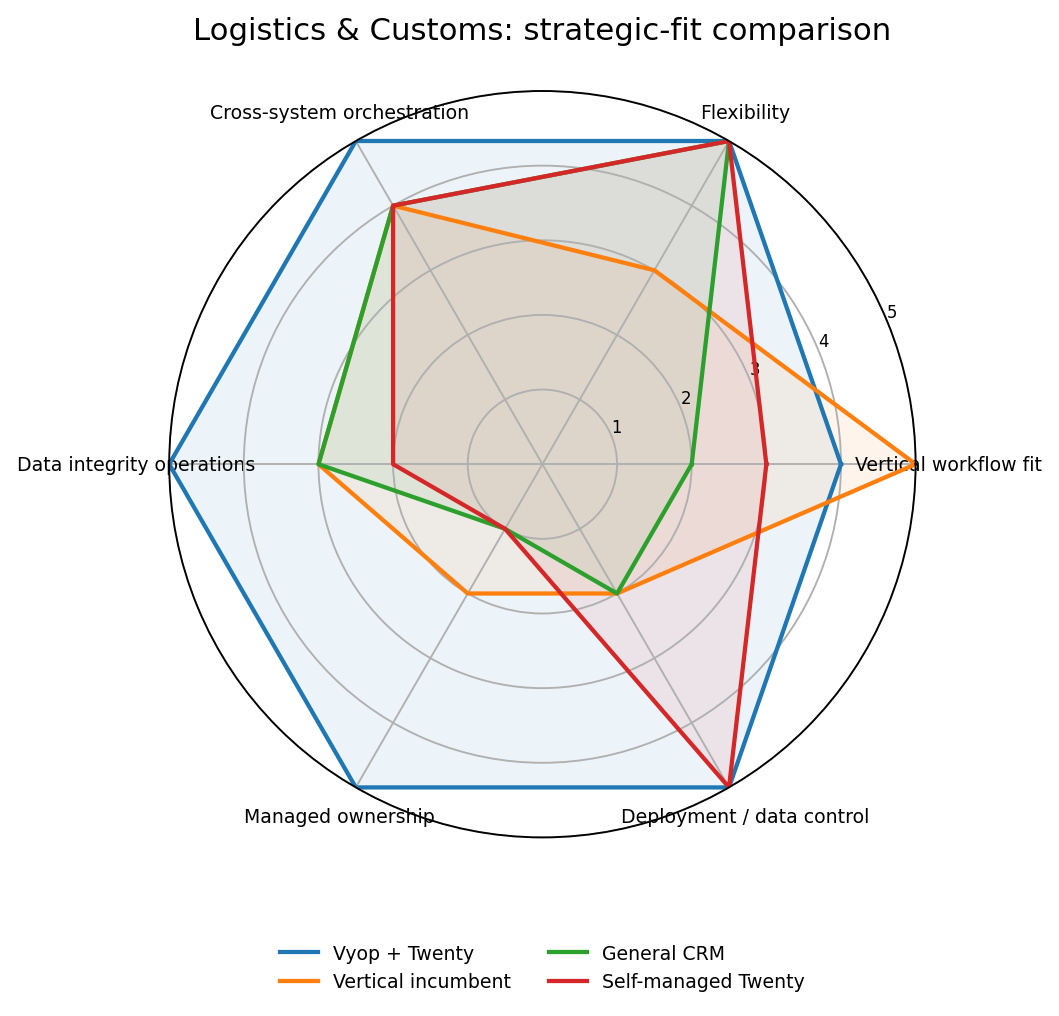
The vertical incumbent usually wins on native industry depth. General CRMs win on ecosystem breadth. Self-managed Twenty wins on control. The proposed Vyop model is designed to win where custom orchestration, continuous data integrity and managed operational ownership matter together.
The radar chart uses the same directional 1–5 scores shown in the comparison table.
Fit
Who should—and should not—choose this approach?
Best fit
Freight forwarders, customs brokers and import-heavy B2B operators whose commercial teams must react quickly to changing trade conditions across many client/product combinations.
Probably not a fit
Organizations looking for customs classification, CARM filing, freight execution or a TMS replacement.
Buyer questions
Questions worth answering before you buy
Research & guides
Tariff Alerts Are Not Enough: The Missing Layer Is Customer Impact →Evidence
Sources used for this comparison
Vendor links are used to verify what those products claim to offer. Regulatory and professional-body sources are used for obligation and industry-context claims. Vyop's comparison and recommended architecture are analysis, not claims made by those sources.
- Canada Border Services Agency, Import and tariff information (Government)
- Canada Border Services Agency, CARM notice (Government)
- Magaya, Digital freight platform (Official product source)
- Descartes, CustomsInfo Manager (Official product source)
Last reviewed: 2026-09-09. Because CRM, AI and regulatory capabilities change, comparison pages should be re-reviewed at least quarterly and whenever a cited product changes materially.
See whether the managed layer is actually justified
The first assessment should identify your systems of record, the exceptions your team still reconciles manually, the data-quality failures that break reporting, and which actions genuinely require human judgment.
Request a CRM Operating Assessment