Turn compliance change into book-of-business action
The CRM should do more than store households and schedule reviews. It should keep client information current, map regulatory or client changes to the affected book, create owned actions, preserve evidence and escalate exceptions to advisors or compliance staff.
Research reviewed 2026-09-09. Product and regulatory claims link to primary sources below.
Direct answer
What is the best CRM role for a Canadian financial advisory or insurance firm?
The CRM should do more than store households and schedule reviews. It should keep client information current, map regulatory or client changes to the affected book, create owned actions, preserve evidence and escalate exceptions to advisors or compliance staff.
Search topics covered:CRM for financial advisors Canadainsurance broker CRM CanadaKYC CRM workflowFINTRAC CRMmanaged CRM for advisors
The problem
Where the operating gaps actually are
The operating burden is continuous: client facts change, reviews lapse, licences expire, regulators update expectations and the firm still has to prove what happened.
KYC information goes stale
A CRM can hold KYC fields, but the real control is knowing when information needs review and proving the refresh was completed.
AML monitoring creates recurring casework
Where FINTRAC obligations apply, information currency, risk reassessment and records are continuing processes rather than one-time onboarding steps.
Regulatory change is hard to translate into client impact
Reading a rule is different from identifying which advisors, households, products or policies need action.
Licensing and registration are deadline-driven
Expiry, renewal and jurisdiction changes need an owned workflow and evidence.
Review and renewal cadence is easy to automate—and easy to ignore
Simple reminders are table stakes. The useful layer prioritizes overdue work and shows whether it actually closed.
Portfolio, policy and CRM data may not share one model
Impact mapping fails when account, policy, household and contact relationships are fragmented.
Compliance evidence needs structure
The firm should be able to show what changed, what was reviewed, by whom, when and what action followed.
AI requires supervision
AI can draft, classify and summarize, but regulated workflows need clear approval boundaries and auditability.
The managed model
How Vyop would run the layer
The exact automation and integrations depend on the source systems and governance requirements of each client.
Five-way comparison
Vyop vs the alternatives
Vs Wealthbox / advisor-specific CRMs
What the vertical incumbent does well: Advisor-specific households, tasks, workflows, integrations, communication history and established wealth-tech ecosystems. Where Vyop fits: Do not claim a better generic advisor CRM. Position Vyop around Canadian compliance operations: KYC/AML/licensing freshness, regulatory-change impact mapping, evidence and managed data integrity.
Vs general CRMs
General CRMs offer deep customization and enterprise ecosystems. The buyer still has to design the compliance data model, integrate policy/portfolio systems and maintain the rule logic. Vyop/Twenty should compete on a lighter, managed operating layer rather than enterprise breadth.
Vs self-managed Twenty / in-house CRM
Self-managed Twenty can hold the same KYC, policy and licence objects. Vyop's value is keeping integrations, rule packs, recurring audits, evidence models and human approval workflows current.
Vs other managed CRM services
Other CRM consultancies can configure workflows and data. The differentiator has to be a maintained Canadian regulatory operations playbook and measurable file-freshness/exception control—not generic CRM administration.
Directional scorecard
Star comparison by operating requirement
| Option | Vertical workflow fit | Flexibility | Cross-system orchestration | Data integrity operations | Managed ownership | Deployment / data control | Choose it when… |
|---|---|---|---|---|---|---|---|
| Vyop Managed CRM on Twenty | Best when the problem is cross-system, requires a bespoke operating model and needs continuous managed ownership. | ||||||
| Wealthbox / advisor-specific CRMs | Best when native vertical depth and system-of-record functionality matter more than bespoke cross-system orchestration. | ||||||
| Salesforce / Dynamics / HubSpot | Best when enterprise breadth, ecosystem and internal CRM capability justify the larger platform. | ||||||
| Self-managed Twenty | Best for organizations with technical ownership that want open customization and can run the operating model themselves. | ||||||
| Other managed CRM services | Best for conventional CRM implementation, administration, migration and RevOps without a deep vertical operating layer. |
How to read this: 1–5 scores are Vyop's directional strategic-fit assessment based on product scope and the managed-service model—not an independent lab benchmark, uptime test or universal product rating. They are intentionally explicit so buyers can challenge the assumptions.
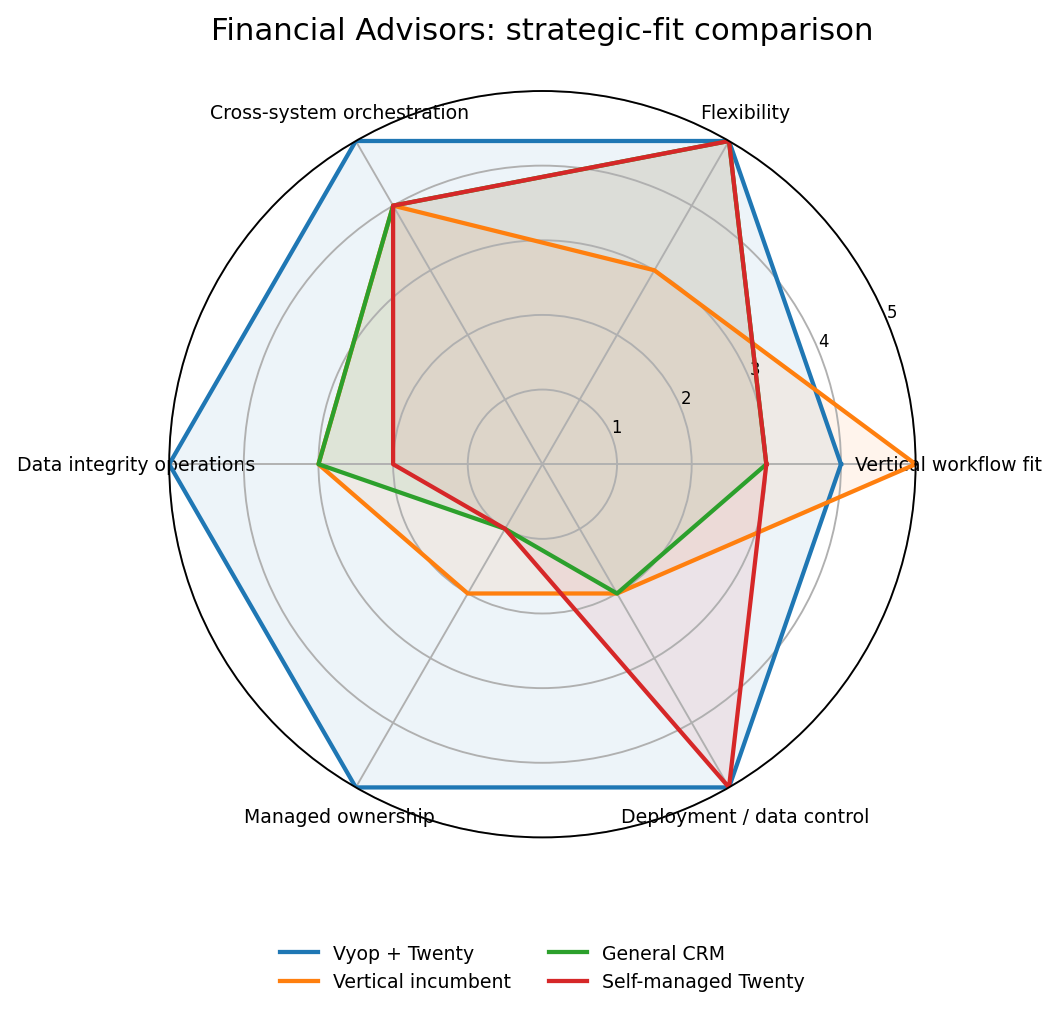
Spider chart
The shape of the trade-off
The vertical incumbent usually wins on native industry depth. General CRMs win on ecosystem breadth. Self-managed Twenty wins on control. The proposed Vyop model is designed to win where custom orchestration, continuous data integrity and managed operational ownership matter together.
The radar chart uses the same directional 1–5 scores shown in the comparison table.
Fit
Who should—and should not—choose this approach?
Best fit
Independent advisory, wealth and insurance firms that need a configurable CRM layer but do not want to build and continuously maintain their own compliance operations stack.
Probably not a fit
Firms that need a dedicated transaction-monitoring, portfolio-accounting or regulatory filing platform rather than a CRM/orchestration layer.
Buyer questions
Questions worth answering before you buy
Evidence
Sources used for this comparison
Vendor links are used to verify what those products claim to offer. Regulatory and professional-body sources are used for obligation and industry-context claims. Vyop's comparison and recommended architecture are analysis, not claims made by those sources.
- CIRO, Compliance Report 2026 (Regulator)
- FINTRAC, Ongoing monitoring requirements (Regulator)
- Wealthbox, CRM API (Official product source)
- Twenty, Pricing and platform capabilities (Official platform source)
Last reviewed: 2026-09-09. Because CRM, AI and regulatory capabilities change, comparison pages should be re-reviewed at least quarterly and whenever a cited product changes materially.
See whether the managed layer is actually justified
The first assessment should identify your systems of record, the exceptions your team still reconciles manually, the data-quality failures that break reporting, and which actions genuinely require human judgment.
Request a CRM Operating Assessment