The CRM layer for the work your EMR does not finish
For a family medicine practice, a CRM should not replace the EMR. Its best role is to manage the operational work around the chart: unresolved referrals, third-party forms, billing exceptions, recall queues, staff handoffs and the data-quality checks that keep those workflows reliable.
Research reviewed 2026-09-09. Product and regulatory claims link to primary sources below.
Direct answer
What should a CRM do for a family medicine practice?
For a family medicine practice, a CRM should not replace the EMR. Its best role is to manage the operational work around the chart: unresolved referrals, third-party forms, billing exceptions, recall queues, staff handoffs and the data-quality checks that keep those workflows reliable.
Search topics covered:managed CRM for family physiciansmedical practice CRM OntarioCRM beside EMRphysician referral trackinghealthcare workflow CRM
The problem
Where the operating gaps actually are
The biggest opportunity is not another patient database. It is the administrative work that crosses the EMR, inbox, forms, staff queues and outside organizations—then becomes invisible until someone notices it.
Administrative work fragments across systems
Charting-related follow-up, forms, office work, lab/result follow-up and other tasks compete for physician and staff time.
Referral loops become exception work
A sent referral is not the same as a completed referral. Practices need a way to surface what is overdue, who owns the follow-up and when the physician actually needs to intervene.
Third-party forms are repetitive but judgment-sensitive
Insurance, disability and other forms can often be pre-filled or drafted from existing information, but final clinical attestation still requires physician review.
Billing exceptions can hide in routine operations
The value is not replacing billing. It is identifying unresolved exceptions or missing operational steps early enough for staff to act.
Recall lists need prioritization, not just reminders
A long list of overdue patients is not an operating system. Staff need a ranked work queue, ownership and closure tracking.
Bad status data breaks automation
If referral, form or recall status fields are stale, dashboards and AI simply automate the wrong picture.
Privacy changes the architecture
PHIPA-sensitive information, model selection, logging and hosting choices all need deliberate controls and human approval.
The managed model
How Vyop would run the layer
The exact automation and integrations depend on the source systems and governance requirements of each client.
Five-way comparison
Vyop vs the alternatives
Vs OSCAR Pro / other EMRs
What the vertical incumbent does well: Clinical chart, prescribing, billing, certified health-system workflows, scheduling and increasingly AI/reminders. Where Vyop fits: Keep the EMR as the clinical system of record. Use Vyop/Twenty as the managed non-clinical control layer for exceptions, cross-system work, audit and escalation.
Vs general CRMs
Salesforce, Dynamics and HubSpot can model administrative workflows, but they still need healthcare-specific configuration, integrations and governance. Their breadth is useful for large enterprises; it can also create more implementation and licensing complexity than a focused practice needs.
Vs self-managed Twenty / in-house CRM
A technically capable practice or IT provider can self-host and configure Twenty. The missing piece is usually not the fields—it is maintaining EMR mappings, workflow rules, audit checks, upgrades, privacy controls and support over time.
Vs other managed CRM services
A generic CRM MSP can migrate data, automate tasks and build dashboards. Vyop should win only if it owns a repeatable healthcare operating model: domain-specific queues, data audits, PHIPA-aware deployment choices and human escalation inside the workflow.
Directional scorecard
Star comparison by operating requirement
| Option | Vertical workflow fit | Flexibility | Cross-system orchestration | Data integrity operations | Managed ownership | Deployment / data control | Choose it when… |
|---|---|---|---|---|---|---|---|
| Vyop Managed CRM on Twenty | Best when the problem is cross-system, requires a bespoke operating model and needs continuous managed ownership. | ||||||
| OSCAR Pro / other EMRs | Best when native vertical depth and system-of-record functionality matter more than bespoke cross-system orchestration. | ||||||
| Salesforce / Dynamics / HubSpot | Best when enterprise breadth, ecosystem and internal CRM capability justify the larger platform. | ||||||
| Self-managed Twenty | Best for organizations with technical ownership that want open customization and can run the operating model themselves. | ||||||
| Other managed CRM services | Best for conventional CRM implementation, administration, migration and RevOps without a deep vertical operating layer. |
How to read this: 1–5 scores are Vyop's directional strategic-fit assessment based on product scope and the managed-service model—not an independent lab benchmark, uptime test or universal product rating. They are intentionally explicit so buyers can challenge the assumptions.
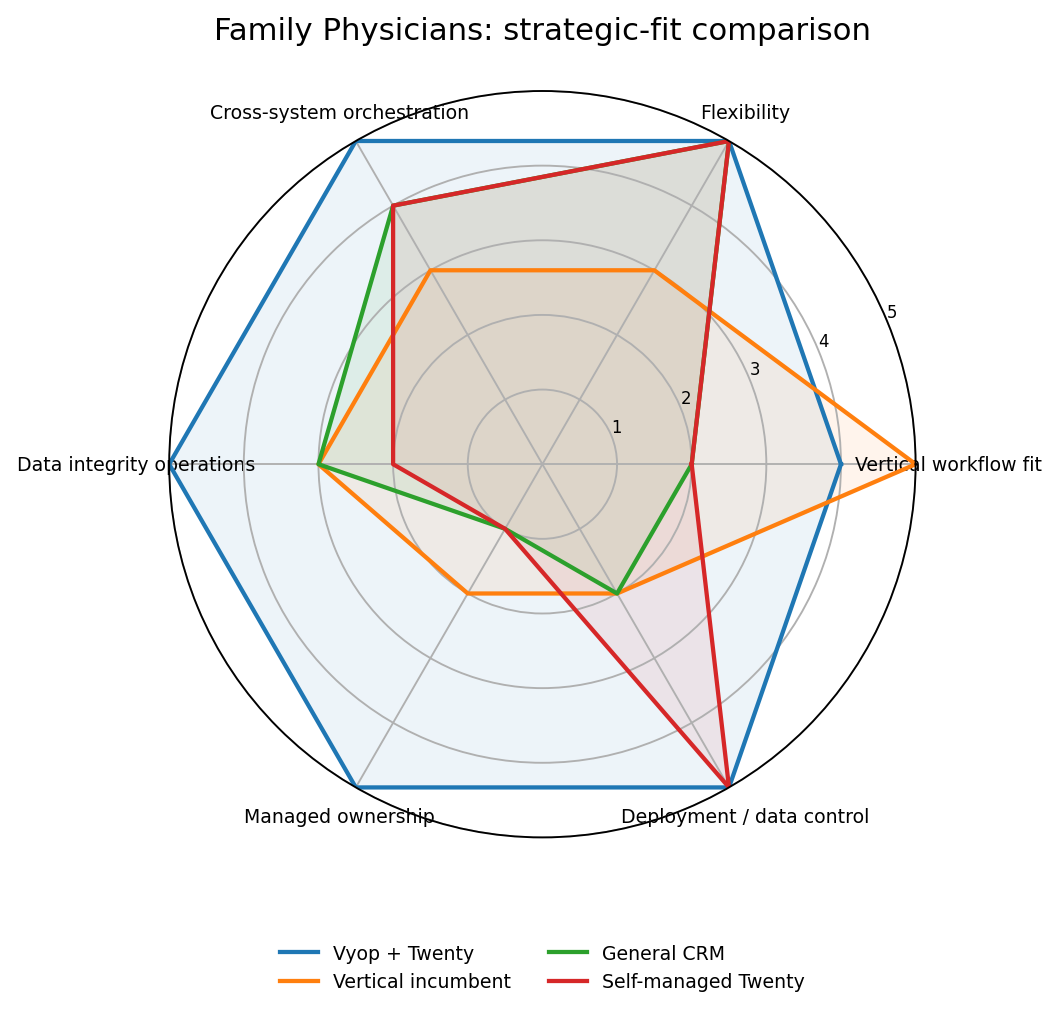
Spider chart
The shape of the trade-off
The vertical incumbent usually wins on native industry depth. General CRMs win on ecosystem breadth. Self-managed Twenty wins on control. The proposed Vyop model is designed to win where custom orchestration, continuous data integrity and managed operational ownership matter together.
The radar chart uses the same directional 1–5 scores shown in the comparison table.
Fit
Who should—and should not—choose this approach?
Best fit
Ontario family practices or primary-care groups that already have an EMR but still rely on inboxes, spreadsheets, staff memory or manual reconciliation for non-clinical follow-up.
Probably not a fit
A practice looking to replace its EMR, billing engine, prescribing system or certified clinical record.
Buyer questions
Questions worth answering before you buy
Evidence
Sources used for this comparison
Vendor links are used to verify what those products claim to offer. Regulatory and professional-body sources are used for obligation and industry-context claims. Vyop's comparison and recommended architecture are analysis, not claims made by those sources.
- Canadian Medical Association, Administrative burden (Independent professional association)
- OSCAR Pro, Product features (Official product source)
- Twenty, Pricing and platform capabilities (Official platform source)
Last reviewed: 2026-09-09. Because CRM, AI and regulatory capabilities change, comparison pages should be re-reviewed at least quarterly and whenever a cited product changes materially.
See whether the managed layer is actually justified
The first assessment should identify your systems of record, the exceptions your team still reconciles manually, the data-quality failures that break reporting, and which actions genuinely require human judgment.
Request a CRM Operating Assessment