One operating layer across every dental location
For a DSO, the strongest CRM role is not to replace the practice-management system. It is to normalize patient, location and treatment-status data across different PMSs, create common management KPIs, surface revenue and retention exceptions, and enforce the same follow-up process across locations.
Research reviewed 2026-09-09. Product and regulatory claims link to primary sources below.
Direct answer
What should a CRM do for a multi-location dental group?
For a DSO, the strongest CRM role is not to replace the practice-management system. It is to normalize patient, location and treatment-status data across different PMSs, create common management KPIs, surface revenue and retention exceptions, and enforce the same follow-up process across locations.
Search topics covered:DSO CRMmulti-location dental CRMdental group CRMDentrix CRM integrationClearDent CRM integration
The problem
Where the operating gaps actually are
Dental software already does a great deal. The opportunity appears higher up the stack: a DSO that acquires or operates multiple locations may inherit different systems, definitions and front-desk practices.
Different locations run different PMS workflows
The DSO may have no single operational vocabulary for patient status, treatment status, recall or ownership.
Treatment opportunity becomes fragmented management data
Unaccepted treatment is important, but the distinctive DSO problem is seeing and working it consistently across systems and sites.
Recall and no-show processes vary by location
Messaging products can automate reminders; group management still needs a common exception and accountability layer.
Duplicate and inconsistent patient records distort reporting
Cross-location growth and migrations increase the cost of poor master data.
Management dashboards are not the same as management control
A KPI becomes operational only when a weak number drills into the exact records, owners and actions that can change it.
Acquisitions create integration sprawl
PMS, payments, communications, reviews and analytics can overlap without one model of truth.
Front-desk execution varies
A shared workflow and escalation policy can reduce the operational variance between practices.
Patient-data access needs least privilege
Cross-location visibility should be designed deliberately rather than granted simply because a centralized CRM exists.
The managed model
How Vyop would run the layer
The exact automation and integrations depend on the source systems and governance requirements of each client.
Five-way comparison
Vyop vs the alternatives
Vs ClearDent / Dentrix / Eaglesoft + RevenueWell / Weave / Dental Intelligence
What the vertical incumbent does well: Scheduling, billing, clinical records, patient communications, treatment follow-up, recall, practice analytics and increasingly multi-location management. Where Vyop fits: Use the installed dental systems as sources of truth. Vyop/Twenty becomes a DSO control layer that normalizes data, applies group-wide rules, audits cross-location integrity and routes exceptions.
Vs general CRMs
Salesforce or Dynamics can centralize the same information, but require a larger implementation and still need dental connectors and a DSO data model. Twenty is attractive when the group wants a focused, configurable control layer rather than another enterprise suite.
Vs self-managed Twenty / in-house CRM
A DSO with internal engineering can build the integrations and dashboards. Vyop should package the patient/location master model, reusable connectors, audit rules, exception SLAs and ongoing operational support.
Vs other managed CRM services
Generic CRM firms can build dashboards and integrations. The DSO-specific edge is maintaining cross-PMS normalization and tying every KPI to an owned exception queue.
Directional scorecard
Star comparison by operating requirement
| Option | Vertical workflow fit | Flexibility | Cross-system orchestration | Data integrity operations | Managed ownership | Deployment / data control | Choose it when… |
|---|---|---|---|---|---|---|---|
| Vyop Managed CRM on Twenty | Best when the problem is cross-system, requires a bespoke operating model and needs continuous managed ownership. | ||||||
| ClearDent / Dentrix / Eaglesoft + RevenueWell / Weave / Dental Intelligence | Best when native vertical depth and system-of-record functionality matter more than bespoke cross-system orchestration. | ||||||
| Salesforce / Dynamics / HubSpot | Best when enterprise breadth, ecosystem and internal CRM capability justify the larger platform. | ||||||
| Self-managed Twenty | Best for organizations with technical ownership that want open customization and can run the operating model themselves. | ||||||
| Other managed CRM services | Best for conventional CRM implementation, administration, migration and RevOps without a deep vertical operating layer. |
How to read this: 1–5 scores are Vyop's directional strategic-fit assessment based on product scope and the managed-service model—not an independent lab benchmark, uptime test or universal product rating. They are intentionally explicit so buyers can challenge the assumptions.
Spider chart
The shape of the trade-off
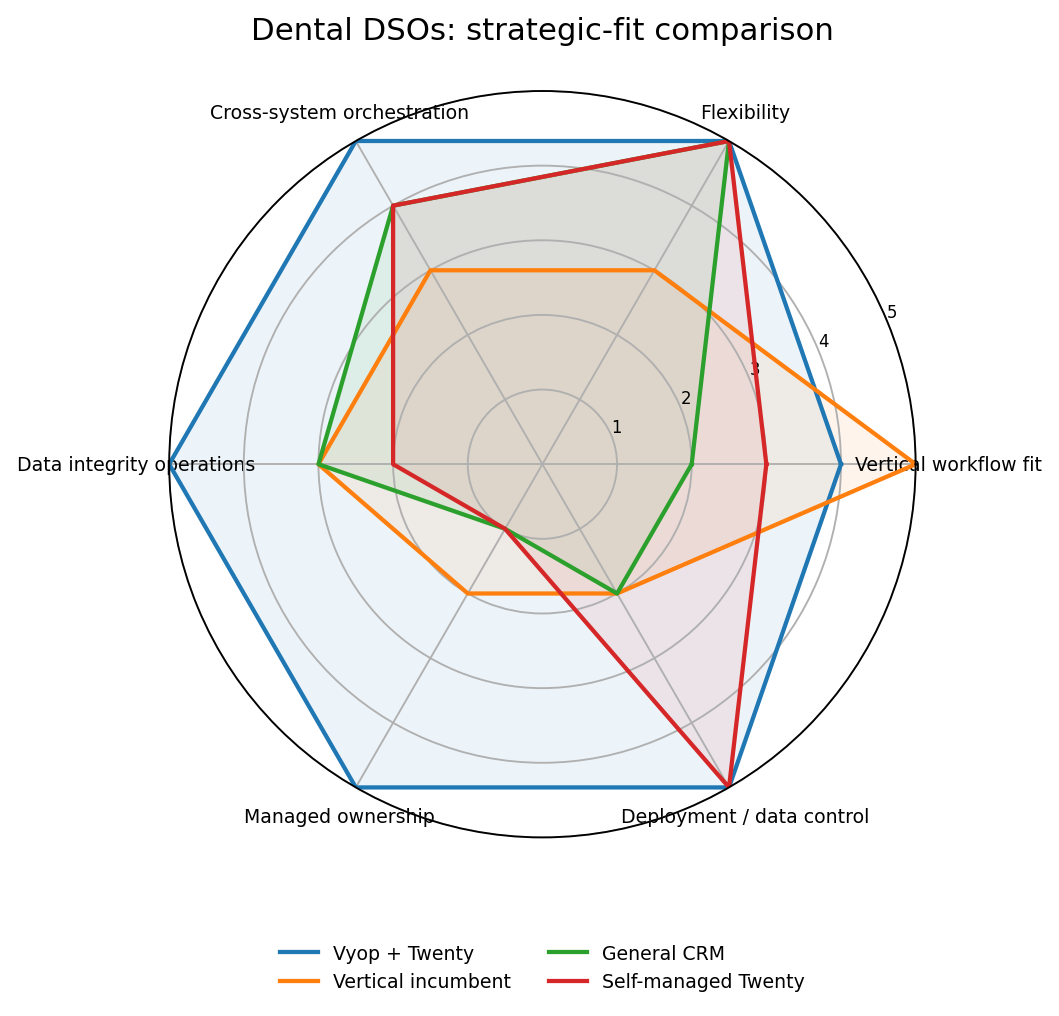
The vertical incumbent usually wins on native industry depth. General CRMs win on ecosystem breadth. Self-managed Twenty wins on control. The proposed Vyop model is designed to win where custom orchestration, continuous data integrity and managed operational ownership matter together.
The radar chart uses the same directional 1–5 scores shown in the comparison table.
Fit
Who should—and should not—choose this approach?
Best fit
Growing dental groups with multiple practices, acquired locations, mixed PMS environments or inconsistent management processes.
Probably not a fit
A single-site clinic that is already satisfied with its PMS, patient communications and analytics and has no meaningful cross-system workflow gap.
Buyer questions
Questions worth answering before you buy
Research & guides
The DSO CRM Opportunity Is Not Another Reminder System →Evidence
Sources used for this comparison
Vendor links are used to verify what those products claim to offer. Regulatory and professional-body sources are used for obligation and industry-context claims. Vyop's comparison and recommended architecture are analysis, not claims made by those sources.
- ClearDent, Dental practice management platform (Official product source)
- RevenueWell, Treatment plan follow-up (Official product source)
- Weave, Analytics (Official product source)
- Twenty, Pricing and platform capabilities (Official platform source)
Last reviewed: 2026-09-09. Because CRM, AI and regulatory capabilities change, comparison pages should be re-reviewed at least quarterly and whenever a cited product changes materially.
See whether the managed layer is actually justified
The first assessment should identify your systems of record, the exceptions your team still reconciles manually, the data-quality failures that break reporting, and which actions genuinely require human judgment.
Request a CRM Operating Assessment