Use a CRM where practice-management software stops
A separate CRM makes sense when relationship, sales and engagement workflows cross multiple systems and the practice-management suite cannot model the firm's way of working. For standard tax/accounting workflows, products such as Canopy, TaxDome, Karbon or Financial Cents may already be the better primary system.
Research reviewed 2026-09-09. Product and regulatory claims link to primary sources below.
Direct answer
When does an accounting or consulting firm need a separate CRM?
A separate CRM makes sense when relationship, sales and engagement workflows cross multiple systems and the practice-management suite cannot model the firm's way of working. For standard tax/accounting workflows, products such as Canopy, TaxDome, Karbon or Financial Cents may already be the better primary system.
Search topics covered:CRM for accounting firms Canadaconsulting firm CRMprofessional services CRM Canadaaccounting CRM workflowmanaged CRM consulting
The problem
Where the operating gaps actually are
This vertical needs disciplined positioning because the incumbents are capable. Vyop should not sell a second system simply to recreate document chasing, onboarding or recurring work that a practice-management suite already handles.
Sales-to-delivery handoff can cross tools
Scope, relationship context, engagement ownership and billing expectations can drift between CRM, proposal, PM and accounting systems.
Bespoke advisory work does not fit standard templates
Multidisciplinary firms often have engagement structures that differ from tax/accounting practice-management assumptions.
Capacity information may live away from pipeline context
Managers need to connect likely work, committed delivery and staffing decisions.
Client document/status data becomes duplicated
When portals, file stores, email and engagement systems overlap, the firm can lose one clear operating state.
Recurring workflows are necessary but not differentiating
The key question is whether a standard practice-management system already does them adequately.
Relationship and cross-sell visibility may be weak
Consulting/advisory firms often need account relationship mapping beyond engagement execution.
AI output still requires professional review
Confidentiality, accuracy and professional responsibility place limits on autonomous use.
Data integrity matters across the client lifecycle
Bad client, engagement or responsibility data damages both workflow and reporting.
The managed model
How Vyop would run the layer
The exact automation and integrations depend on the source systems and governance requirements of each client.
Five-way comparison
Vyop vs the alternatives
Vs Canopy / TaxDome / Karbon / Financial Cents
What the vertical incumbent does well: Accounting-firm CRM, workflow, portal, document collection, billing, capacity and increasingly AI in integrated suites. Where Vyop fits: Use those products when the firm's work matches them. Use Vyop/Twenty only where the firm has bespoke relationship and cross-system operating requirements that justify a configurable layer.
Vs general CRMs
General CRMs are strong for consulting sales and relationship management but need integration with project delivery, accounting and document systems. Twenty can be a lighter alternative where the workflow model is bespoke.
Vs self-managed Twenty / in-house CRM
Self-managed Twenty suits technically mature firms that want full control. Vyop adds reusable engagement models, integrations, audit rules, optimization and support.
Vs other managed CRM services
Many CRM consultants can implement a bespoke system. Vyop should target a narrow, repeatable professional-services pattern and connect the CRM to measurable delivery and data-quality outcomes.
Directional scorecard
Star comparison by operating requirement
| Option | Vertical workflow fit | Flexibility | Cross-system orchestration | Data integrity operations | Managed ownership | Deployment / data control | Choose it when… |
|---|---|---|---|---|---|---|---|
| Vyop Managed CRM on Twenty | Best when the problem is cross-system, requires a bespoke operating model and needs continuous managed ownership. | ||||||
| Canopy / TaxDome / Karbon / Financial Cents | Best when native vertical depth and system-of-record functionality matter more than bespoke cross-system orchestration. | ||||||
| Salesforce / Dynamics / HubSpot | Best when enterprise breadth, ecosystem and internal CRM capability justify the larger platform. | ||||||
| Self-managed Twenty | Best for organizations with technical ownership that want open customization and can run the operating model themselves. | ||||||
| Other managed CRM services | Best for conventional CRM implementation, administration, migration and RevOps without a deep vertical operating layer. |
How to read this: 1–5 scores are Vyop's directional strategic-fit assessment based on product scope and the managed-service model—not an independent lab benchmark, uptime test or universal product rating. They are intentionally explicit so buyers can challenge the assumptions.
Spider chart
The shape of the trade-off
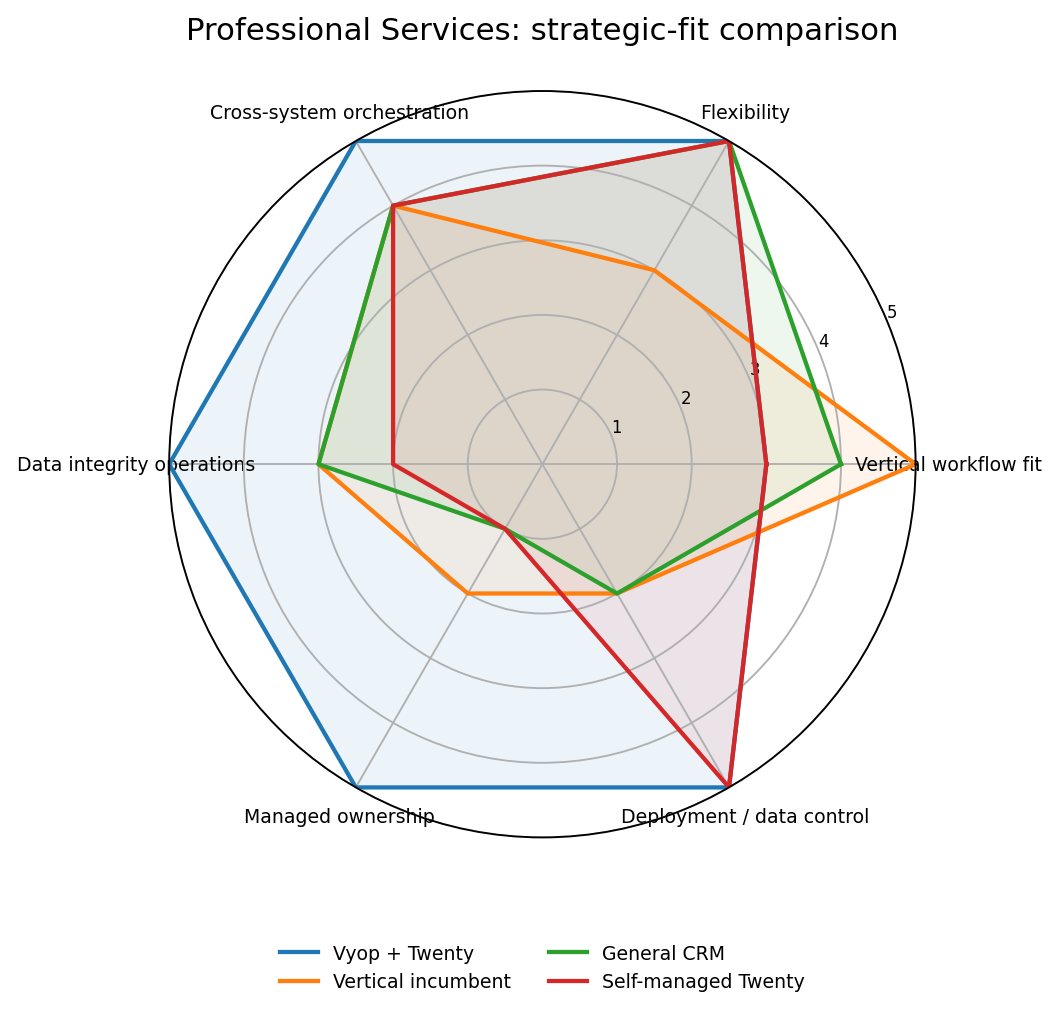
The vertical incumbent usually wins on native industry depth. General CRMs win on ecosystem breadth. Self-managed Twenty wins on control. The proposed Vyop model is designed to win where custom orchestration, continuous data integrity and managed operational ownership matter together.
The radar chart uses the same directional 1–5 scores shown in the comparison table.
Fit
Who should—and should not—choose this approach?
Best fit
Consulting, advisory or multidisciplinary professional-services firms with complex relationship and engagement workflows spanning multiple systems.
Probably not a fit
A standard accounting practice whose existing practice-management suite already handles CRM, workflow, portal, documents, billing and capacity effectively.
Buyer questions
Questions worth answering before you buy
Research & guides
When an Accounting Firm Should Not Add Another CRM →Evidence
Sources used for this comparison
Vendor links are used to verify what those products claim to offer. Regulatory and professional-body sources are used for obligation and industry-context claims. Vyop's comparison and recommended architecture are analysis, not claims made by those sources.
- CPA Ontario, Responsible use of AI (Professional regulator)
- Canopy, Practice management platform (Official product source)
- TaxDome, Accounting CRM (Official product source)
- Twenty, Pricing and platform capabilities (Official platform source)
Last reviewed: 2026-09-09. Because CRM, AI and regulatory capabilities change, comparison pages should be re-reviewed at least quarterly and whenever a cited product changes materially.
See whether the managed layer is actually justified
The first assessment should identify your systems of record, the exceptions your team still reconciles manually, the data-quality failures that break reporting, and which actions genuinely require human judgment.
Request a CRM Operating Assessment